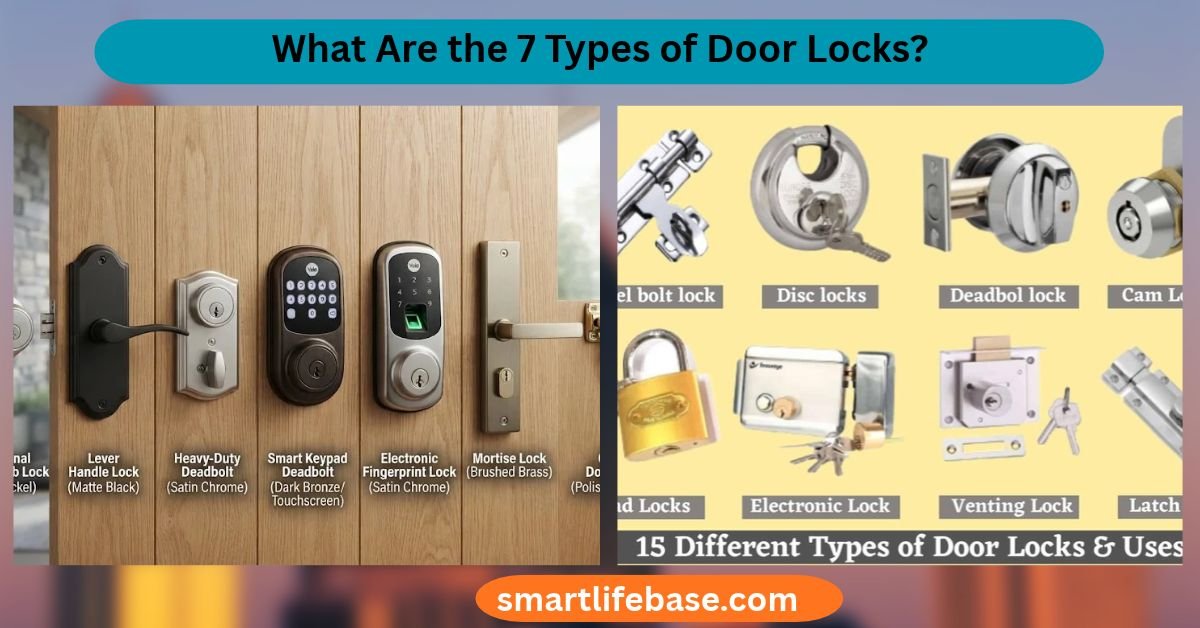
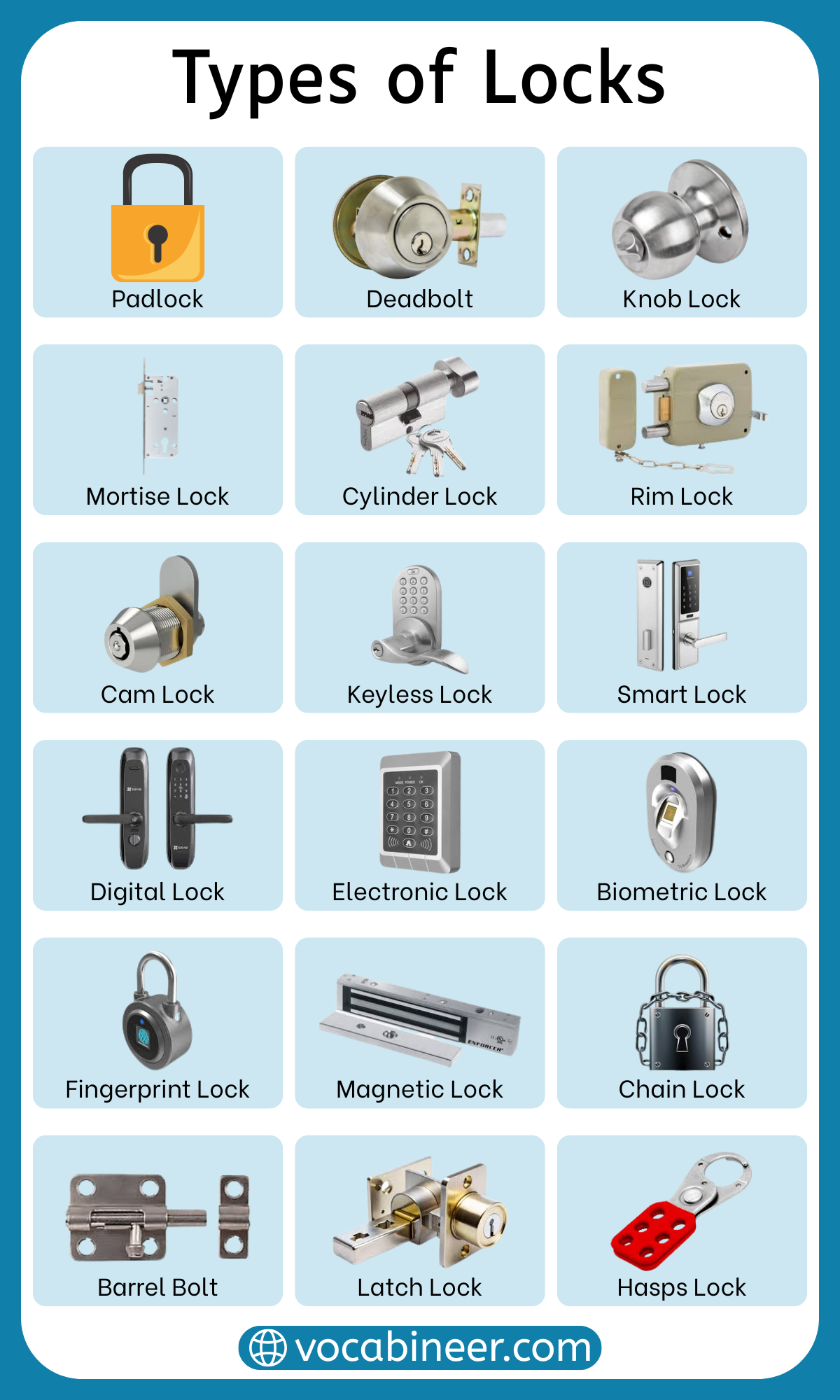
What Are the 7 Types of Door Locks? Compare their features, uses, security benefits, and limitations to choose the right lock for your door. The seven common types of door locks are deadbolt locks, knob locks, lever handle locks, mortise locks, cylindrical locks, rim locks, and smart locks.
Each type has a different design, locking method, level of protection, and ideal use.
In American homes, apartments, offices, and commercial buildings, door locks play a key role in controlling access and protecting people and property. From a front entry door in Texas to an apartment door in New York, the right lock depends on the door design, daily use, and security needs. However, not all locks provide the same level of protection.
Some locks use a solid metal bolt, while others rely on a spring-loaded latch, a key cylinder, or an electronic system. Knowing these differences makes it easier to choose suitable hardware for your property. It also helps you avoid common mistakes, such as using a basic privacy lock where a stronger exterior lock is needed.
This guide explains seven common door lock types, how each one works, where it is normally used, and its main advantages and limitations. It also covers American lock security grades, installation factors, and practical ways to choose a suitable option without relying on appearance alone.
There are many ways to classify door locks. Some names describe the locking mechanism, while others describe the handle, installation method, or access technology. This is why different guides may list different numbers of door lock types.
For a practical comparison, the seven categories below cover common residential and commercial door hardware in the United States. They are not all completely separate mechanical designs. For example, a cylindrical lock may have a knob or lever, while a smart lock may operate a deadbolt.
Use electronic controls, such as keypads, mobile apps, biometric readers, or digital credentials.
Are These Seven Types Completely Different?
No. Some categories describe how a lock is built, while others describe how a person operates it. For example, a lever handle is a form of door hardware, and the mechanism behind it may be cylindrical or mortise-based.
This distinction matters when buying replacement hardware. A door with a cylindrical lock may accept a different handle style, but it will not necessarily accept a mortise lock without changes to the door. Always check the existing preparation and the new lock’s specifications.
What Are the 7 Types of Door Locks?
Construction
Mortise and cylindrical describe how the lock body fits into the door.
Operation
Deadbolts, knobs, and levers describe different locking or operating methods.
Access technology
Smart locks describe electronic access and control features.
1. Deadbolt Locks
Deadbolt locks are among the most common choices for securing exterior residential doors in the United States. They use a solid metal bolt that moves into the door frame when someone turns a key or an interior thumbturn. Unlike a standard spring latch, a deadbolt does not automatically retract when pressure is applied to the door.
Many homeowners install a deadbolt above a standard knob or lever lock. This provides a separate locking point and makes the entry door more difficult to open by simply manipulating its handle. However, the lock’s performance also depends on the door, frame, strike plate, and installation quality.
What Are the 7 Types of Door Locks?
What Are the 7 Types of Door Locks
Source: Fantastic Services
Main advantage
The solid bolt provides an additional layer of protection against forced entry compared with relying only on a basic spring latch.
Common location
Front doors, rear doors, garage entry doors, and other exterior residential doors.
Main limitation
A deadbolt cannot compensate for a weak door, damaged frame, or poorly secured strike plate.
Single-Cylinder Deadbolts
A single-cylinder deadbolt has a key cylinder on the outside and a thumbturn on the inside. A person outside needs a key, while someone inside can usually lock or unlock the door by turning the thumbturn.
This design is widely used on American residential entry doors. It allows quick exit without requiring a key, which is an important practical safety feature.
Best suited for
Most standard residential entry doors where convenient interior operation is important.
Double-Cylinder Deadbolts
A double-cylinder deadbolt uses a key on both sides of the door. This design can reduce the risk of someone reaching through nearby glass and turning an interior thumbturn.
However, it introduces a serious safety concern. Someone inside may need a key to exit during a fire or another emergency. Local building and fire codes may restrict its use, so homeowners should consult the relevant authority before installing one.
What Are the 7 Types of Door Locks?
Best suited for
Limited situations where the surrounding door design creates a specific security concern and local codes permit the lock.
How to Choose a Deadbolt
Look for a deadbolt with a suitable ANSI/BHMA performance grade, a strong bolt, and a design that matches the door thickness and backset. Backset is the distance from the door edge to the center of the lock opening.
For an exterior door, also inspect the strike plate and frame. A longer strike plate with suitable screws can improve the connection to the framing when installed correctly. Follow the hardware manufacturer’s instructions rather than assuming every door needs the same setup.
Check the bolt
Confirm that it extends fully into a compatible strike opening.
Check the door
Make sure the door and frame are sound and properly aligned.
2. Knob Locks
Knob locks are door locks with a round or oval knob that turns to operate a latch. Depending on the model, the locking feature may use a push button, a turn mechanism, or an exterior key cylinder. Their familiar design makes them common in American homes and smaller commercial spaces.
These locks are often used on bedroom doors, closets, and interior rooms. Some models are also installed on exterior doors, but a standard keyed knob lock should not be treated as the only security measure for a main entry door. The knob and locking cylinder are exposed, and the design may be less resistant to force than a properly installed deadbolt.
What Are the 7 Types of Door Locks?
Easy operation
Users can open and close the door by turning the knob without needing to operate a separate handle.
Wide availability
Knob locks are available in many finishes, sizes, and locking functions.
Security limitation
The knob itself can be a weak point when the lock is used alone on an exterior entry door.
Common Types of Knob Locks
Passage knob locks do not have a locking function. They are designed for doors that need to open and close freely, such as hallways and closets.
Privacy knob locks include an interior locking feature, often with an emergency release on the outside. They are common in bedrooms and bathrooms where privacy is more important than high security.
Keyed entry knob locks use an exterior key cylinder and an interior locking control. They can be useful as part of a larger entry door system, particularly when paired with a separate deadbolt.
What Are the 7 Types of Door Locks?
Passage knobs
Used where no lock is required.
Privacy knobs
Used for bedrooms and bathrooms.
Keyed entry knobs
Used on doors that require key-controlled access.
When Should You Choose a Knob Lock?
Choose a knob lock when the door needs simple operation, a traditional appearance, and a suitable locking function. For an interior room, a privacy knob may be enough.
For a main exterior door, consider using a properly rated deadbolt as the primary security lock. This approach separates everyday handle operation from the main locking function.
Good choice
Interior rooms, closets, and suitable secondary doors.
Use with caution
Exterior doors that need stronger protection against forced entry.
What Are the 7 Types of Door Locks
3. Lever Handle Locks
Lever handle locksuse a horizontal handle that moves down to operate the door latch. They are often easier to use than round knobs because a person can open the door with a hand, wrist, or elbow. This makes them useful in homes, offices, and public buildings.
Lever locks are available in passage, privacy, and keyed entry versions. Their internal construction may be cylindrical, tubular, or mortise-based, depending on the product. Therefore, the handle shape alone does not tell you how strong the lock is.
Many commercial buildings use lever handles because they are practical for frequent use and accessible operation. When choosing one, check its intended application, performance grade, and compatibility with the door.
What Are the 7 Types of Door Locks?
Main advantage
The handle is simple to operate and can support accessible door use.
Common location
Offices, schools, bedrooms, bathrooms, and residential entry doors with suitable lock systems.
Main limitation
A lever handle is not automatically more secure than a knob. Security depends on the complete lock mechanism and door assembly.
Passage Lever Locks
Passage lever locks have no locking function. They allow free movement between rooms and are useful for hallways, kitchens, and other interior spaces.
Typical use
Interior doors that need convenient access without privacy controls.
Privacy Lever Locks
Privacy lever locks allow a user to lock the door from inside. Many models have an emergency release feature that allows authorized access from outside when needed.
They are common on bedrooms and bathrooms. However, they are designed for privacy rather than protection against forced entry.
Typical use
Bedrooms, bathrooms, and private interior spaces.
Keyed Entry Lever Locks
Keyed entry lever locks have a key cylinder on the exterior side and a locking control on the interior side. They can be installed on suitable exterior or controlled-access doors.
Check the product’s security rating and intended use before selecting one. For a primary residential entrance, a separate deadbolt may provide an additional locking point.
Typical use
Exterior entry doors and suitable commercial access doors.
4. Mortise Locks
Mortise locks contain a lock body that fits inside a specially cut pocket in the edge of the door. This recessed design allows the lock to contain several parts within one assembly, such as a latch, deadbolt, and additional locking features.
These locks are widely used in commercial and institutional buildings, including offices, schools, and healthcare facilities. They are also found in some residential properties where the door is designed to accept mortise hardware.
A major benefit is their range of functions. Depending on the model, a mortise lock can combine a secure locking bolt with a handle arrangement that supports convenient exit. This is useful in buildings where access control and occupant movement must work together.
What Are the 7 Types of Door Locks?
What Are the 7 Types of Door Locks
Source: locksandhardware.co.uk
Main advantage
A single lock body can support several locking and operating functions.
Common location
Commercial buildings, institutional properties, and compatible residential doors.
Main limitation
Installation is more involved because the door needs a suitable mortise pocket and related openings.
How Does a Mortise Lock Work?
The lock body sits inside a recessed section of the door. A handle operates the latch, while a key cylinder or thumbturn controls the locking function, depending on the design.
Some mortise locks include a deadbolt and an auxiliary deadlocking latch. These components can provide more functions than a simple spring-latch lockset. The exact features depend on the model and its intended application.
What Are the 7 Types of Door Locks?
Lock body
The main mechanism fitted inside the door.
Cylinder
The part that accepts the key and controls the locking mechanism.
Strike plate
The frame-mounted part that receives the latch or bolt.
Mortise Locks for Commercial Buildings
Commercial properties often need locks that support different access functions. A classroom may need a particular locking arrangement, while an office may require controlled entry and a suitable free-exit function.
Mortise hardware can offer these options, but the correct function must match the building’s occupancy, fire protection, and applicable egress requirements. A qualified door hardware professional can help specify the correct model.
Useful feature
Multiple operating and locking functions in one assembly.
Installation advice
Use a qualified installer when door preparation or commercial code compliance is involved.
5. Cylindrical Locks
Cylindrical locks,also called bored locks, are installed through holes drilled into the door. Their main locking components sit in a chassis within the door, while the handle or knob operates the latchbolt.
They are common in American residential and commercial buildings because installation is usually simpler than that of a mortise lock. They are available in many functions, including passage, privacy, and keyed entry.
Cylindrical locks are not all equal in strength. Commercial models may meet higher performance requirements than basic residential models. Their security depends on the grade, construction, cylinder, door preparation, and installation.
What Are the 7 Types of Door Locks?
Main advantage
They are relatively straightforward to install and offer many operating options.
Common location
Offices, schools, apartment buildings, retail spaces, and homes.
Main limitation
A single-latch design may offer fewer locking functions than some mortise systems.
Cylindrical vs. Tubular Locks
The terms cylindrical and tubular are sometimes used loosely, but professional hardware references distinguish between these constructions. Tubular locks generally have a simpler center spindle arrangement and are common in residential interior applications.
Cylindrical locks use a more developed chassis and latch assembly. Commercial cylindrical products are available in different performance grades and may support more demanding applications.
Always check the manufacturer’s exact product classification rather than relying on the appearance of the handle.
Tubular
A common option for basic residential interior doors.
Cylindrical
Available in residential and commercial configurations with different performance levels.
When Are Cylindrical Locks a Good Choice?
A cylindrical lock is a practical choice when you need a replacement that fits a compatible bored door. It can be suitable for an office, apartment, or interior residential door.
For a high-use commercial opening, compare tested grades and the manufacturer’s intended application. Do not assume that every lock with a similar shape has the same durability or security performance.
Best for
Compatible doors that need practical installation and a wide choice of lock functions.
6. Rim Locks
Rim locksare mounted on the inside surface of a door rather than being fitted entirely into its edge. Their lock body remains visible, while a matching cylinder or other operating component controls the mechanism from the opposite side.
A common example is a night latch. When the door closes, a spring-loaded latch may engage automatically. The user can then open the door from inside with a handle or turn control, while an exterior key cylinder controls outside access.
Rim locks are found on older homes, traditional timber doors, and some secondary entrances. They can also be used as an additional locking mechanism when the door design supports the installation.
What Are the 7 Types of Door Locks?
Main advantage
The lock body can be installed on the door surface without cutting a large mortise pocket.
Common location
Traditional timber doors, older properties, and compatible secondary entry doors.
Main limitation
The exposed lock body and mounting arrangement must be suitable for the door and the expected security needs.
Night Latch Locks
A night latch is a type of rim-mounted locking device that can engage when the door closes. The exterior side commonly uses a key cylinder, while the interior side has a handle or turn control.
This automatic latching feature can help reduce the chance of leaving a door unlatched. However, it does not make every night latch suitable as the only lock on an exterior entrance.
Useful feature
Automatic latching when a compatible door closes.
Rim Locks for Older Properties
Older wooden doors may have limited space for modern lock preparations. A rim lock can sometimes provide a practical replacement or additional locking option without major changes to the door.
Before buying one, check the door thickness, mounting surface, cylinder compatibility, and frame condition. A locksmith can help determine whether the existing door can support the chosen hardware.
Installation consideration
The door surface must provide a firm and suitable mounting area.
7. Smart Locks
Smart locksuse electronic systems to control access to a door. Depending on the model, a user may unlock the door with a PIN, mobile app, fingerprint, access card, or another approved credential. Some models also support physical keys.
They are becoming a common option for American homes, rental properties, and offices where people want to manage access without sharing traditional keys. Some products allow owners to create temporary codes for guests, cleaners, or service providers.
Smart locks offer convenience, but electronic access does not automatically mean better physical security. A smart lock still needs a suitable mechanical locking system, a properly fitted door, and secure account settings.
What Are the 7 Types of Door Locks?
Main advantage
Users can manage access through digital credentials and, on supported models, remotely.
Common location
Residential front doors, rental properties, offices, and controlled-access spaces.
Main limitation
Battery failure, connectivity issues, software weaknesses, and account security can affect operation.
Keypad Smart Locks
Keypad smart locksallow users to enter a numerical code instead of carrying a physical key. Some models support several user codes, which can be changed or removed when access is no longer needed.
They are useful for households with several occupants and properties that receive regular visitors. Choose a model with clear code-management controls and a suitable backup entry method.
Main benefit
Convenient entry without a physical key for every user.
Wi-Fi and Bluetooth Smart Locks
Bluetooth smart locks usually communicate with a nearby mobile device. Wi-Fi-enabled models may support remote control through an internet connection, although some products require a separate bridge or hub.
Before buying, check whether remote access requires a subscription, whether the lock works with your phone, and what happens when the internet connection is unavailable.
What Are the 7 Types of Door Locks?
Bluetooth
Typically supports nearby device-based access.
Wi-Fi
May support remote access and notifications when configured correctly.
Fingerprint Smart Locks
Fingerprint locksuse a biometric reader to identify an enrolled fingerprint. This can reduce the need to remember a code or carry a key.
Their performance depends on sensor quality, correct enrollment, and the user’s ability to present a readable fingerprint. Users should also understand the backup entry method and how biometric data is handled and stored.
Main benefit
Quick access for enrolled users without a traditional key.
Main consideration
Check biometric data handling, backup access, and manufacturer support.
What Are the 7 Types of Door Locks?
How to Keep a Smart Lock Secure
Start by changing default access codes and using a unique password for the associated account. Enable available security updates and use multifactor authentication when supported.
Check battery levels regularly and understand how to enter the property if the battery runs out. Keep any emergency key or approved backup method in a safe and accessible location.
Before installation, confirm that the smart lock fits your existing deadbolt or door preparation. A retrofit model may preserve the existing exterior hardware, while a full replacement may require different measurements and installation work.
Update regularly
Install available firmware and app updates.
Protect access
Use unique passwords and avoid sharing permanent access codes unnecessarily.
Plan for outages
Understand the battery warning system and backup entry method.
How Do the 7 Types of Door Locks Compare?
The best way to compare door locks is to look at their construction, intended use, operating method, and limitations. A lock designed for an interior bedroom does not have the same purpose as a lock designed for a main exterior entrance.
The following table provides a practical overview. It describes typical applications, not a universal security ranking. A well-made and correctly installed lock may perform differently from a poorly made product in the same category.
What Are the 7 Types of Door Locks?
Deadbolt
A strong option for residential exterior doors when properly rated and installed.
Knob
A convenient option for everyday interior access and suitable secondary applications.
Lever
A practical option where easy handle operation is useful.
Mortise
A versatile option for commercial and compatible residential doors.
Cylindrical
A common choice for compatible bored doors in homes and commercial buildings.
Rim
A useful option for suitable surface-mounted applications.
Smart
An access-control option for users who want electronic credentials and access management.
Which Lock Type Is Best for Different Doors?
For a typical American front door, a properly installed deadbolt paired with a suitable handle lock is a common practical arrangement. A mortise lock may be appropriate when the door and hardware are designed for that system.
For a bedroom, a privacy knob or privacy lever is usually more appropriate than a high-security exterior lock. For an office, a commercial-grade cylindrical or mortise lock may offer the required access functions.
For an older timber door, a suitable rim lock may be worth considering. For a home that needs code-based access, a compatible smart deadbolt may be useful.
Main exterior entrance
Consider a suitable deadbolt or an appropriately specified mortise system.
Bedroom
Consider a privacy knob or privacy lever.
Office
Consider a commercial cylindrical or mortise lock.
Older wooden door
Consider a compatible rim lock or suitable replacement hardware.
Digital access
Consider a smart lock with a reliable backup entry method.
What Are the 7 Types of Door Locks
What Do ANSI/BHMA Lock Grades Mean?
ANSI/BHMA grades help buyers compare the tested performance of door hardware. The Builders Hardware Manufacturers Association develops standards that cover areas such as operation, strength, durability, and security testing.
In the United States, many lock products are evaluated under applicable ANSI/BHMA standards. Grade 1 generally represents the highest performance level in the relevant graded category, followed by Grade 2 and Grade 3. However, the exact testing requirements depend on the product standard.
A Grade 1 label should not be treated as proof that every component in a door assembly is equally strong. The complete installation matters, and different lock categories have different standards.
What Are the 7 Types of Door Locks?
Grade 1
The highest performance grade within the applicable graded product standard. Often considered for demanding commercial applications.
Grade 2
A middle performance grade that may suit many residential and light commercial applications, depending on the product.
Grade 3
A lower performance grade within the relevant standard, commonly associated with basic residential applications.
Check the Correct Standard
ANSI/BHMA A156.2 covers bored and preassembled locks and latches. ANSI/BHMA A156.13 covers mortise locks and latches, while ANSI/BHMA A156.12 covers interconnected locks.
These standards have different scopes. A buyer should compare products within the correct category instead of assuming that every Grade 1 lock has been tested in exactly the same way.
Laboratory test results also have limits. Actual performance may vary with installation, maintenance, door construction, and environmental conditions.
Read the product documentation
Check the exact standard and grade claimed by the manufacturer.
Compare similar products
Use the same product category and applicable performance standard.
Inspect the complete door
Consider the lock, strike, frame, hinges, and door material together.
How to Choose the Right Door Lock for Your Property
Choosing the right door lock starts with the door itself. A lock that works well on a solid wooden door may not fit an aluminum, glass, or composite door. The right choice also depends on who uses the door and how often it opens.
Instead of choosing a lock based only on its price or appearance, compare its physical compatibility, security requirements, ease of use, and maintenance needs.
What Are the 7 Types of Door Locks?
1. Identify the door location
Decide whether the lock is for an exterior entrance, bedroom, bathroom, office, garage entry, or another location.
2. Check the door material
Identify whether the door is wood, metal, fiberglass, aluminum, or another material.
3. Measure the existing hardware
Check door thickness, backset, bore diameter, edge preparation, and the available space for the lock.
4. Decide the access method
Choose between a physical key, thumbturn, keypad, app, biometric reader, or a combination.
5. Compare performance
Review the applicable ANSI/BHMA grade and manufacturer specifications.
6. Check safety requirements
Make sure the locking arrangement supports safe exit and follows applicable building and fire codes.
7. Consider installation
Determine whether the lock is a suitable replacement or requires professional door preparation.
Consider the Total Cost
The purchase price is only one part of the cost of a door lock. Installation, replacement parts, batteries, hubs, subscriptions, and future maintenance can affect the total expense.
A basic mechanical lock may have fewer ongoing costs, while a smart lock may need batteries and compatible electronic equipment. A mortise lock may also cost more to install if the door needs additional preparation.
Compare the complete cost over the expected service life rather than choosing the lowest advertised price.
Mechanical locks
Usually require less electronic maintenance.
Smart locks
May require batteries, app support, compatible devices, and optional subscriptions.
Mortise locks
May require more specialized installation and replacement work.
Think About Household Needs
A family with children may prefer a lock with simple interior operation and a clear emergency exit arrangement. An older adult or someone with limited hand movement may find a lever handle easier to use than a round knob.
A rental property owner may value temporary codes and the ability to change access after a tenant leaves. An office manager may need different access permissions for employees and visitors.
The best lock is the one that meets the property’s actual needs without creating unnecessary access or safety problems.
What Are the 7 Types of Door Locks?
Accessibility
Consider lever handles and easy-to-operate controls.
Shared access
Consider suitable keyed systems or smart locks with managed user credentials.
Emergency exit
Ensure the inside locking arrangement allows safe and lawful egress.
What Are the 7 Types of Door Locks
Common Door Lock Mistakes to Avoid
Even a well-made lock can provide poor results when it is installed incorrectly or used for the wrong purpose. Some common mistakes involve ignoring the door frame, choosing an unsuitable locking function, or assuming that electronic access automatically improves security.
Review the following issues before installing or replacing a lock.
What Are the 7 Types of Door Locks?
Using a knob lock alone on an exterior door
A standard knob lock may not provide the protection expected from a separate deadbolt or suitable high-performance locking system.
Ignoring the door frame
A strong bolt cannot provide its intended benefit if the frame or strike area is damaged or poorly secured.
Buying incompatible hardware
Differences in door thickness, backset, bore size, and lock preparation can prevent correct installation.
Ignoring emergency exit needs
Some locking arrangements can make exit difficult if they require a key or special operation from inside.
Forgetting smart lock maintenance
Low batteries, outdated software, and weak account passwords can create access problems.
Assuming all Grade 1 products are identical
Performance grades are tied to specific standards and product categories.
When Should You Call a Locksmith?
A qualified locksmith can help when a door needs new preparation, the existing lock does not fit standard replacement hardware, or the locking mechanism has become damaged.
Professional help is also useful for commercial doors, mortise lock replacements, access-control systems, and situations involving fire or building code requirements.
If a lock repeatedly sticks, the key becomes difficult to turn, or the door needs excessive force to close, have the alignment and hardware inspected. Do not force the key or make major changes to a fire-rated or commercial door without suitable guidance.
Damaged lock
Get professional help if the cylinder, bolt, or internal mechanism is damaged.
Complex installation
Use a qualified installer for mortise and commercial locking systems.
Code concerns
Consult a qualified professional or local authority before changing an exit door’s locking function.
How to Maintain Different Types of Door Locks
Regular maintenance helps door locks work as intended and can reduce unexpected failures. The right maintenance method depends on the lock’s construction and the manufacturer’s instructions.
Inspect the door, handle, strike plate, and visible hardware from time to time. If the door becomes difficult to close or the bolt does not line up with the strike, correct the underlying alignment issue rather than forcing the lock.
What Are the 7 Types of Door Locks?
Inspect the hardware
Check for loose screws, visible damage, rust, and signs of unusual wear.
Check door alignment
Make sure the latch and bolt move freely into their intended openings.
Use suitable products
Follow the lock manufacturer’s guidance for cleaning and lubrication.
Check smart lock batteries
Replace batteries according to the manufacturer’s instructions and respond to low-battery alerts.
Review access credentials
Remove unused smart lock codes and update access permissions when needed.
Can You Lubricate Every Door Lock the Same Way?
No. Different lock cylinders and internal mechanisms may require different products. Some manufacturers recommend specific dry lubricants or other approved products, while certain oils may attract dirt or affect internal components.
Check the product manual before applying lubricant. If a lock remains stiff after basic inspection and approved maintenance, a locksmith can identify whether the problem comes from the cylinder, latch, door alignment, or frame.
Avoid guesswork
Use only products approved for the specific lock.
Do not force the mechanism
A stuck key or bolt may indicate a deeper mechanical or alignment issue.
What Are the 7 Types of Door Locks
Research Notes and Useful Next Questions
The seven categories in this guide are a practical editorial classification, not an official universal list. Manufacturer documentation from Schlage distinguishes mechanical lock constructions such as tubular, cylindrical, mortise, interconnected, and deadbolt systems. ANSI/BHMA also maintains separate performance standards for several of these categories.
The reviewed door lock guides use different classification systems. Some focus on British mortise and night-latch hardware, while American commercial hardware references place greater emphasis on cylindrical and mortise construction. This guide uses American residential and commercial applications as its main market.
A useful distinction for readers is that the handle style, lock construction, and access technology are not always separate categories. This distinction helps prevent incorrect comparisons when choosing replacement hardware.
What Are the 7 Types of Door Locks?
Observed question: What type of lock is best for a front door?
Coverage in reviewed pages: Answered at a general level. Reader benefit: Understand why a suitable deadbolt and a strong door frame matter.
Inferred next need: Can a smart lock work without Wi-Fi?
Coverage in reviewed pages: Not checked in detail. Reader benefit: Understand the difference between local Bluetooth operation, keypad access, and remote internet access.
Inferred next need: Can you replace a knob lock with a deadbolt?
Coverage in reviewed pages: Shallow. Reader benefit: Check door preparation, measurements, and installation compatibility before buying.
Inferred next need: How do ANSI/BHMA grades differ?
Coverage in reviewed pages: Answered at a general level. Reader benefit: Compare the correct standard and grade for the product category.
Inferred next need: How often should a door lock be maintained?
Coverage in reviewed pages: Not checked in detail. Reader benefit: Follow manufacturer maintenance instructions and identify problems early.
Suggested Supporting Articles
Readers who want more detail may benefit from separate guides covering the strongest door lock mechanisms, smart lock installation, deadbolt versus knob lock comparisons, and the differences between single-cylinder and double-cylinder deadbolts.
These topics answer distinct follow-up questions and should be developed as separate supporting articles rather than repeated at length in this introductory guide.
Comparison guide
Deadbolt vs. knob lock: Which provides better exterior door protection?
Installation guide
How to replace a standard residential door lock safely.
Technology guide
Can a smart lock work without Wi-Fi or an internet connection?
Security guide
What makes a door lock ANSI/BHMA Grade 1?
Frequently Asked Questions: What Are the 7 Types of Door Locks
Q
What Are the 7 Types of Door Locks?
The seven common types are deadbolt locks, knob locks, lever handle locks, mortise locks, cylindrical locks, rim locks, and smart locks. They differ in construction, operation, installation, and access methods. Some categories can overlap because they describe different parts of a locking system.
Q
Which Type of Door Lock Is the Most Secure?
There is no single lock type that is always the most secure. A properly specified deadbolt or a suitable high-performance mortise lock can provide strong protection when installed on a sound door and frame.
Look at the applicable ANSI/BHMA grade, cylinder security, bolt design, strike plate, and installation quality. The complete door assembly matters more than the lock’s appearance or category alone.
Q
What Is the Most Common Door Lock in American Homes?
Deadbolts, knob locks, and lever locks are common in American homes. A typical exterior entry door may use a deadbolt together with a knob or lever lock, while interior bedrooms and bathrooms often use privacy hardware.
The exact arrangement depends on the home’s age, door design, and owner’s preferences.
Q
Are Smart Locks More Secure Than Traditional Locks?
Not automatically. Smart locks offer digital access features, such as PIN codes, mobile control, and temporary credentials. However, their physical security still depends on the underlying locking mechanism and installation.
They also introduce electronic risks involving passwords, software, batteries, and connectivity. A well-designed smart lock with secure settings and a reliable mechanical mechanism may be a useful option, but it is not automatically stronger than a quality mechanical lock.
Q
Can I Use a Knob Lock on My Front Door?
Yes, a suitable keyed knob lock can be used on a front door. However, it is generally better not to rely on a basic knob lock as the only security measure.
Consider adding a compatible deadbolt or choosing a properly rated locking system designed for exterior entry doors. Check the door and frame condition before installation.
Q
What Is the Difference Between a Mortise Lock and a Cylindrical Lock?
A mortise lock has a lock body fitted inside a pocket cut into the door edge. A cylindrical lock uses a chassis installed through holes bored into the door.
Mortise systems can support several locking functions in one assembly, while cylindrical locks generally have simpler door preparation. The correct option depends on the door, application, and required performance.
Q
Are Grade 1 Door Locks Better Than Grade 2 and Grade 3?
Grade 1 is the highest performance grade in the applicable ANSI/BHMA graded product category. Grade 2 is the middle level, while Grade 3 is the lower level.
However, grades must be compared within the correct standard. A Grade 1 label does not mean every lock category has undergone identical testing or that installation quality no longer matters.
Q
How Long Does a Door Lock Usually Last?
There is no universal service life for every door lock. Quality, frequency of use, environmental exposure, maintenance, installation, and internal wear all affect how long a lock works properly.
Replace or repair a lock when it shows damage, repeated sticking, unreliable locking, or other signs of failure. Follow the manufacturer’s maintenance guidance and seek professional inspection when needed.
Q
Can I Replace a Traditional Door Lock With a Smart Lock?
Often, yes. Many smart locks are designed to replace compatible deadbolts or retrofit existing hardware. However, compatibility depends on door thickness, backset, bore dimensions, bolt type, and the smart lock’s installation requirements.
Check the manufacturer’s compatibility guide before buying. Some installations may require a locksmith or other qualified installer.
Q
Do All Door Locks Need a Key?
No. Passage locks, privacy locks, keypad locks, fingerprint locks, and some smart locks can operate without a traditional key during normal use.
However, some electronic models include a physical key as a backup. Check the manufacturer’s specifications and understand how the lock works during a power, battery, or connectivity failure.
✦ Wrapping Up
Conclusion
The seven common types of door locks are deadbolt, knob, lever handle, mortise, cylindrical, rim, and smart locks. Each serves a different purpose, and the right choice depends on the door, the building, the required access method, and the level of protection needed.
For most American residential exterior doors, a properly installed deadbolt is a practical starting point. Knob and lever locks are useful for everyday access, while mortise and cylindrical systems serve a wide range of residential and commercial applications. Rim locks can suit certain traditional doors, and smart locks offer additional access-control features.
Before purchasing a lock, check its measurements, applicable ANSI/BHMA performance grade, installation requirements, and safety features. Also inspect the door frame and strike area. A well-matched and correctly installed locking system is more useful than an expensive lock fitted to an unsuitable door.
💡 Key Takeaway
Start by identifying whether your door is an exterior entrance or an interior door. Measure the existing lock preparation, compare suitable products and their applicable ANSI/BHMA grades, and choose a locking system that supports both security and safe exit.
If the door requires major changes or has commercial code requirements, consult a qualified locksmith.
Which Smart Home Device Do You Use The Most? Explore top picks, user stats, and expert tips to choose the best speaker, lights, hub, or security in 2026.